Is GetYourGuide AI-first? Eight ways an OTA would become AI-first
Early 2026 reflections on what it really takes to become AI-first

Johannes Reck recently wrote: “2026 marks the start of a new chapter in GetYourGuide’s history: we’re becoming an AI-first company.”
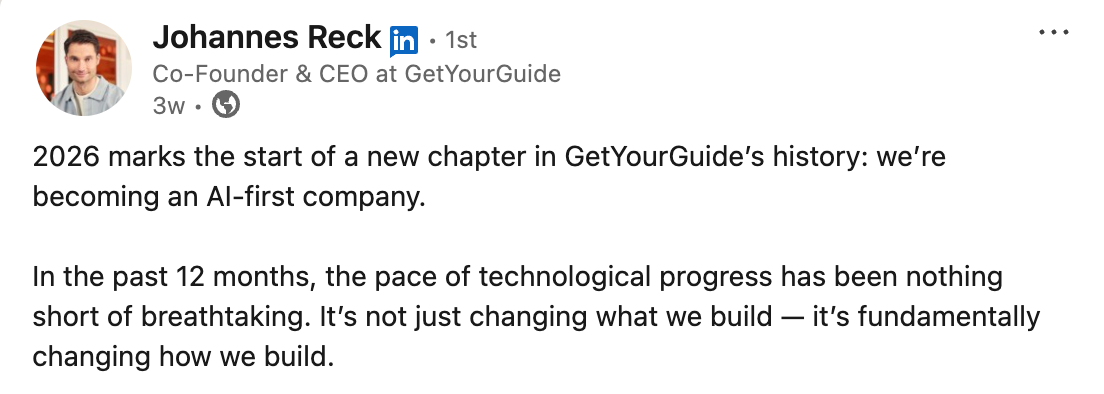
It’s an ambitious statement — and one worth examining seriously.
This isn’t really about one company. Every OTA faces the same structural shift. GetYourGuide simply happens to be saying it publicly. Below are eight ideas — not a checklist — but each pointing toward what being genuinely AI-first would require.
1 — Stop defending the information gap. Compete on the risk gap
OTAs were built to monetise the information gap: what exists, what’s available, how to compare it, and whether a booking will work. They won by aggregating supply and making comparison easy inside a controlled UI.
AI collapses that gap. Discovery, comparison, summarisation, translation, and itinerary assembly are now table stakes for AI agents. An assistant does not need your listings page to know what exists or what fits a user’s preferences. It can infer, synthesise, and recommend without ever touching your UI.
What remains is not information scarcity. What remains is risk.
The real battleground is no longer “Can I find it?” but “Can I commit safely?” Who holds funds? Who enforces terms? Who resolves disputes? What guarantees are machine-readable and reliable when something goes wrong?
Risk management, trust arbitration, payment guarantees, and failure recovery are no longer user-facing features. They are infrastructure for agents making commitments.
If your value disappears the moment an AI can find the product, evaluate fit, and initiate contact, you are not AI-first. You are defending a shrinking surface area.
AI doesn’t need help choosing. It needs help committing.
2 — Rearchitect the core proposition for AI agents, not human users
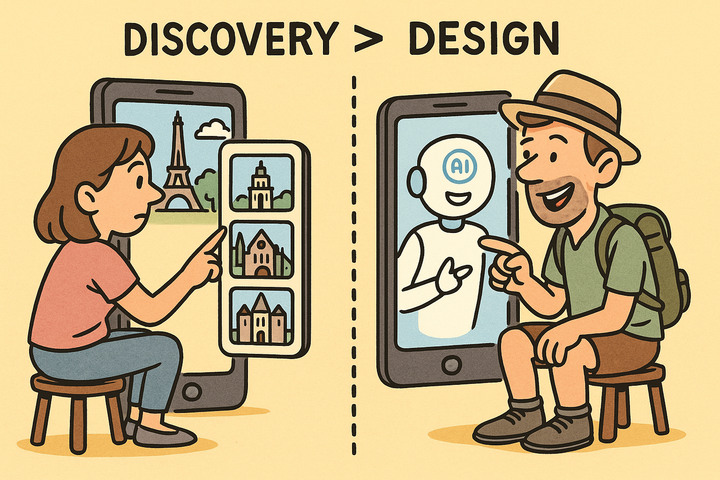
AI does not use a UI the way humans do. An AI-first OTA must assume that browsing becomes optional, that an agent can book direct if it chooses, and that each transaction is not a “booking flow” but a negotiated commitment between machines.
In that world, a consumer agent may talk directly to a tour operator’s agent, confirm constraints, clarify edge cases, and then commit. The OTA is no longer a comparison interface. It becomes infrastructure inside the negotiation.
That forces uncomfortable questions. What does branding mean when there is no screen? What happens when experiences are designed conversationally rather than discovered through listings? What is a review when curation shifts from operator-controlled pages to agent-assembled itineraries?
If your platform only works when a human scrolls it, you have not rearchitected for the AI layer.
3 — Lead, shape, and accelerate AI standards
If AI agents are where decisions are being made, OTAs must do more than adopt standards — they need to help define them.
That means backing real consumer-facing AI protocols, not unofficial MCP endpoints hidden behind partner keys. There are GetYourGuide-branded MCP listings circulating but they rely on partner authentication and appear unofficial — which misunderstands the point. MCP is consumer-facing infrastructure.
This isn’t theoretical — here’s a live example of my Autoura preferences tech working alongside Peek's reztech capability via MCP:
Meanwhile, experimentation is already happening in the open — from OpenClaw flight agents built by startups such as BonBook and Jinko, to a Swiss geo-tourism assistant developed by a DMO, and experience-led skills like GuruWalk’s free tours tool.
Hoteliers are actively aligning around HATPro — an AI-era preference and profile standard — while sightseeing OTAs and tour operators are comparatively quiet. That’s striking, because preference data is arguably even more critical in tours and attractions, where itineraries and experiences can be dynamically personalised.
This isn’t about generic “openness.” It’s about educating the sector, shaping AI-native standards, and ensuring the OTA is structurally embedded wherever agents are actually making commitments.
If you’re not helping shape AI standards, you’re volunteering to operate inside someone else’s.
4 — Distribute and enable accountable AI-operated experiences
AI-only or purely digital products should not qualify as experiences. If there is no accountable, real-world component — a human guide, a staffed venue, a ticketed attraction, or a clearly defined physical service — it does not belong in an experiences marketplace.
Standalone audio tours and unanchored AI layers are content, not experiences, and should be delisted accordingly.
At the same time, OTAs should build the infrastructure that allows operators to create consistent hybrid AI-human formats at scale. Become the distributor and enabler of accountable AI-enhanced experiences — something like “GetYourGuide Digitals” alongside Originals — rather than simply a marketplace listing them.
See Dex from Headout as an early signal.
5 — Rebuild reztech for the AI era
This is a generational opportunity to replace legacy reztech with something AI-native. Most tour operator reservation systems won’t disrupt themselves. OTAs could step in and build a clean, centralised core — payments, availability, guarantees — designed to be agent-callable from day one.
You can’t “vibe code” enterprise reztech for 1,000 operators without introducing chaos. But you can provide a professionally maintained core and enable 1,000 operators to vibe code their own lightweight, low-feature interfaces on top of it. That creates ownership (the IKEA effect), flexibility, and speed — without sacrificing reliability.
If OTAs want to move from marketplace to infrastructure, this is where it happens.
6 — Invest in the AI startup ecosystem
If AI is reshaping distribution, OTAs should be actively shaping the ecosystem — not just observing it. That means real capital, real infrastructure access, and direct engagement with AI-native startups, not only sponsorship of established operator communities.
GetYourGuide deserves credit for supporting tour operator communities like Tourpreneur. But AI-native startups need structural backing too. Last year, I won a Fever innovation competition and received €10,000 to support early-stage AI development. That kind of tangible investment builds relationships early and ensures innovation doesn’t develop in isolation from distribution.
In previous tech cycles, OTAs knew which reztech platforms were scaling and built strategic ties early. The same needs to happen now with AI-native companies — or the next generation of infrastructure will be built without them in mind.
7 — Recognise that the real competition is broader than other OTAs
The competitive set is no longer just other OTAs and how quickly they claim to become AI-first. It’s the interface layer. Google and Samsung can integrate tourism into their ecosystems unilaterally. Mobility platforms like Waymo are already publishing reports on tourism impact. Device, mapping, and transport layers are moving closer to the decision moment.
The immediate reaction might be: what does this have to do with us? Everything. If you digitally transform tourism, you inevitably transform the layers around it — including distribution. You can’t reshape the experience layer without affecting the marketplace layer.
If OTAs don’t redefine their role in that shift, someone operating one layer above them will define it for them.
Read the Waymo Tourism Impact Report (2025)
8 — Demonstrate intellectual curiosity through real-world experiments
AI-first isn’t a positioning statement. It’s a learning posture.
Where are the live pilots, sandbox programmes, and structured field trials? Where are the published learnings from testing new agent behaviours against real supply? AI won’t reshape tourism through slide decks — it will reshape it through experimentation.
In my business we designed 25 autonomous vehicle tour concepts in San Francisco to explore how AI, mobility, and guided experiences might intersect. That kind of prototyping generates insight, even before scale. Yet there is little visible evidence of major OTAs running comparable exploratory programmes or actively seeking structured learning from those experimenting at the edges.
Intellectual curiosity at scale — not announcements — is what separates strategy from marketing.
Conclusion
GetYourGuide is one of the strongest products of the pre-AI OTA generation. They optimised brilliantly for supply aggregation, trust signals, payments, and global distribution — and executed exceptionally well in a world where humans browsed, compared, and decided inside a UI. As a fellow entrepreneur from the same era as the founders, I have real respect for what they built.
But the centre of gravity has shifted. In an AI-mediated world, discovery collapses and commitment remains. If your value disappears when your UI disappears, you are not AI-first. The next era won’t be won by better listings or faster summaries — it will be won by whoever owns risk, guarantees, and agent-to-agent infrastructure. Otherwise, as Peter Syme would say, you’re running up a downward escalator — eroding value faster than you’re creating it.
Further reading
- Whats my predictions for the sector over the next decade? AI and the end of the fixed itinerary tour (PDF)
- Peter Syme: Do GetYourGuide & Viator have a future in an AI world? (LinkedIn)
- Johannes Reck (GetYourGuide CEO): We're becoming an AI first company. (LinkedIn)
Want to read more like this?
Low volume. Short length. Focused content.
We know you're busy — only the good stuff, no noise.